I Took Starlink Camping in the Sierras. Here's What I Actually Learned.
I live in Northern California, so when we go camping around here, we're usually somewhere in the Sierra Nevadas surrounded by an absolutely unreasonable number of trees.
That's great for camping.
It's less great when your internet comes from a satellite.
I put together what is basically a little off-grid internet system: a Starlink Mini, a PREDATOR 350 power station, and a PREDATOR 100W solar panel. People usually call this kind of setup a "solar generator."
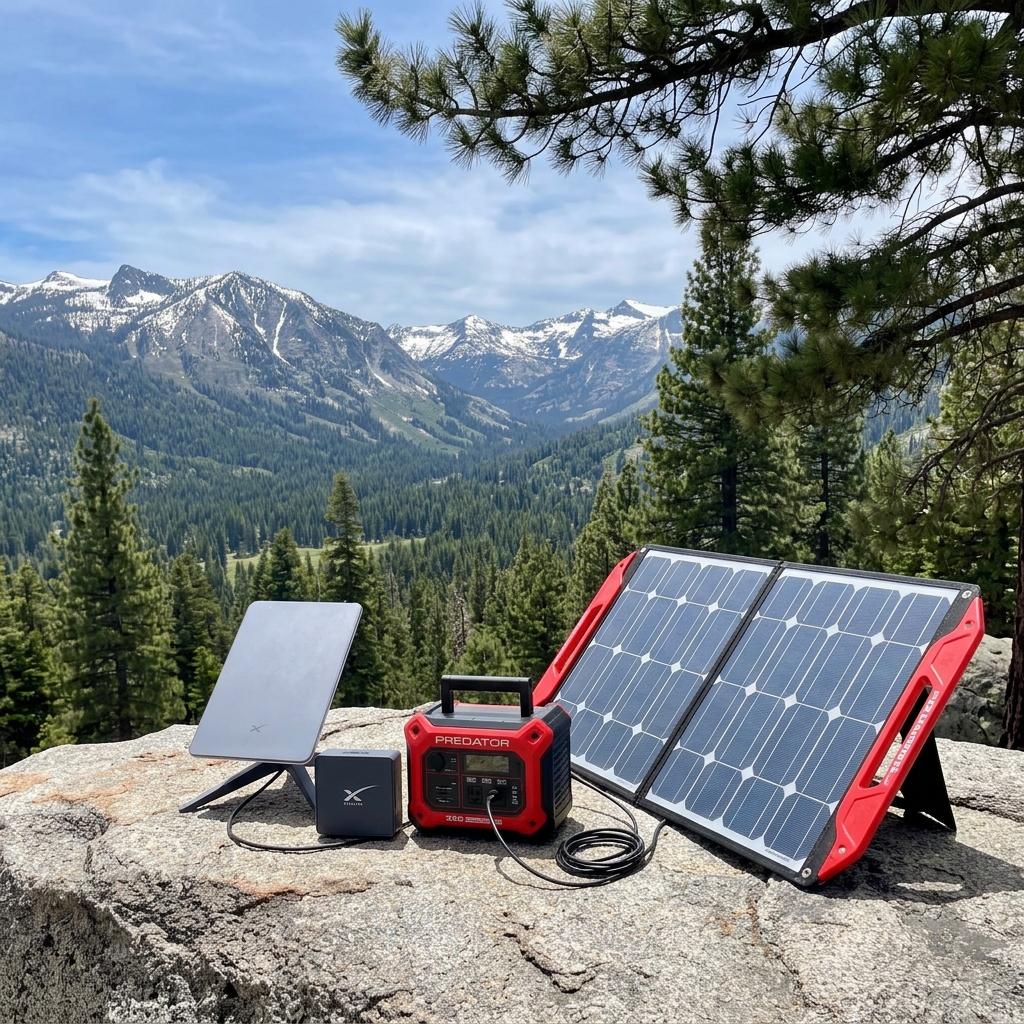
I've used it camping, but also for random day trips to local lakes where there is basically no cell service.
After using it for a while, I've learned that it works really well. It also kind of sucks.
The setup
The Starlink Mini is surprisingly capable. In good conditions I've gotten 300+ Mbps download, with upload speeds that are also perfectly respectable.
The PREDATOR 350 is a 294 Wh LiFePO4 battery. Starlink says the Mini averages roughly 20–40 watts, depending on what it's doing and the conditions. So, in theory, the battery has enough juice to run Starlink for most of a day by itself.
In practice, I don't really use it that way.
During the day I'll leave Starlink running while the solar panel charges the battery. Then when the sun goes down, I'll keep Starlink running into the evening. If everything went perfectly, I'd have plenty of battery left when we go to bed.
The problem is that everything does not go perfectly.
Sometimes the panel isn't producing enough power to keep up with Starlink, so I'll shut Starlink down for a while during the day to make up the deficit. Otherwise, we'd eventually run the battery too low to make it through the night.
And this is where things get interesting.
A 100W solar panel does not mean 100W
The PREDATOR panel is rated for 100 watts.
I almost never get 100 watts.
The panel can be sitting in what looks like direct sunlight and still produce substantially less. That's especially true where I camp.
There are trees everywhere.
Even when a tree isn't obviously blocking the sun, it can still be affecting the amount of light hitting the panel. And the sun moves, so the spot that was perfect at 10 AM might be terrible at 1 PM.
The only time I've consistently managed to get the full 100W was sitting right at the edge of a lake with the sun absolutely blasting everything around me. You know the kind of sunlight where you're going to turn into a tomato if you don't put sunscreen on?
That's 100W weather.
If the conditions are burn-worthy, they're probably 100W-worthy.
The other problem: everything is heavy as hell
The 100W panel weighs about 10.6 pounds by itself.
The PREDATOR 350 weighs another 10 pounds.
Then there's the Starlink, cables, phones, whatever else we're charging, etc.
None of these things are particularly crazy individually. Together, they're a pain in the ass.
And the solar panel creates an even bigger problem because you can't just put it down and forget about it.
In the Sierra, I'm constantly moving the panel around trying to find the best sunlight. Then sometimes I have to move the battery and Starlink with it because I don't have enough cable to put everything exactly where I want it.
Then a couple hours later the sun has moved and I'm doing it again.
It's not exactly portable in the way you imagine when you hear "portable solar generator."
But having internet in the middle of nowhere is pretty awesome
This is the reason I keep bringing it.
We're not using Starlink because we desperately need to watch YouTube while camping.
We're using it because there is no cell service.
Wi-Fi calling becomes really useful when your phone otherwise has absolutely nothing.
Being able to call someone from a campsite in the middle of nowhere is a legitimate safety feature. It's also useful for checking maps, weather, campground information, road conditions, reservations, or just looking something up when you're sitting somewhere that has zero reception.
And the connection is legitimately fast.
Getting 300+ Mbps from a little satellite dish sitting in the woods is still kind of ridiculous.
But for a day trip, I don't bring the solar panel anymore
This is probably the biggest thing I've learned.
For an actual camping trip where we're going to be using Starlink all day and into the night, the solar setup makes sense.
For a three-to-six-hour trip to a local lake?
No thanks.
I've found that one or two DeWalt batteries plus a $5 USB adapter from AliExpress is enough to run the Starlink for the few hours we're actually there.
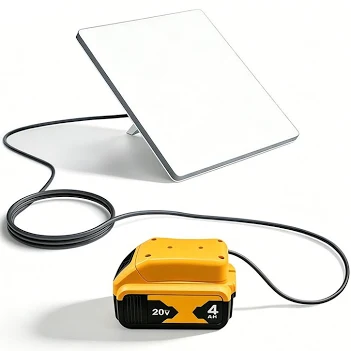
Now I can leave the 10-pound power station and 10-pound solar panel at home.
It's dramatically easier.
And that's probably the real lesson I've gotten from this whole setup.
So is it worth it?
For camping: yeah, absolutely.
The ability to have real internet and Wi-Fi calling somewhere with zero cell service is genuinely useful. The Starlink Mini works surprisingly well, and the PREDATOR 350 + solar panel combination can keep it running for a long time if you manage the power.
But it isn't magic.
The solar panel rarely produces its advertised 100W in the real world. The equipment is heavier and more annoying to move than you might expect. Trees are a problem for both the satellite connection and the solar panel. And if you're constantly moving around trying to chase the sun, the whole "portable" thing starts feeling pretty questionable.
For a short day trip, I've basically abandoned the solar generator entirely.
A couple DeWalt batteries in the car are easier.
For a multi-day camping trip, though, I'll still happily haul the whole ridiculous setup into the woods.